

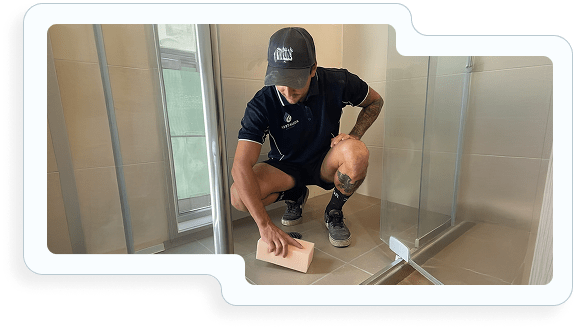
A leaking shower often starts as a cosmetic issue. Grout lines show small dark patches. Mould begins to accumulate in the corners. Within months, the rigid joints between tiles start to crumble, allowing water to pass beneath the surface. In many Australian homes, the default response is to patch the area with standard cement grout or apply a temporary surface sealer.
However, standard grout remains porous after curing, meaning it absorbs moisture, soap oils, and organic matter every time the shower is used. For homeowners seeking a permanent barrier against water entry, epoxy grout has become the primary alternative.
This guide explores the technical structure of epoxy grout, how it performs under real-world conditions, installation costs in the Australian market, and how to determine whether it is the right solution for a leaking shower.
Epoxy grout is a two-part tiling joint filler that cures through chemical reaction rather than water evaporation. It consists of an epoxy resin component and a hardener mixed with a fine silica sand filler. When combined, these ingredients undergo an exothermic reaction that creates a dense cross-linked polymer network.
This chemical cross-linking changes the physical properties of the joint:
Traditional cement-based grout relies on Portland cement, sand, and water. As the water evaporates during the drying process, it leaves behind a network of tiny pores. These pores absorb water via capillary action, creatingq12 a slow path for moisture to migrate behind the tiles.
The choice between these two materials comes down to chemical performance, cost, and installation requirements.
|
Performance Feature |
Traditional Cement Grout |
Epoxy Grout |
|
Chemical Base |
Portland cement and sand |
Epoxy resin and silica sand |
|
Curing Process |
Water evaporation and hydration |
Chemical cross-linking |
|
Water Absorption Rate |
10% to 18% (highly porous) |
Less than 0.5% (non-porous) |
|
Flexural Strength |
Low (3 to 5 MPa) |
High (greater than 30 MPa) |
|
Stain and Mould Resistance |
Low (requires regular sealing) |
High (naturally resistant) |
|
Working Time (Pot Life) |
2 to 3 hours |
30 to 45 minutes |
|
Average Cost Factor |
Baseline |
4 to 5 times higher |
You may also like: Epoxy Grout vs Cement Grout for Tiling Showers, Bathrooms, & Balconies
Water absorption is the primary cause of grout failure in domestic showers. When a porous cement joint absorbs water, the moisture sits inside the joint. If the shower is used daily, the grout never dries out completely. This sustained dampness allows mould spores to penetrate the surface and multiply inside the grout material itself.
Over time, acidic cleaning products used to scrub the mould strip the mineral binders from the cement, making it soft and crumbly. Epoxy grout avoids this cycle because water cannot penetrate the surface, leaving mould with no moisture reservoir to establish roots.
While epoxy’s durability is clear, the material has specific trade-offs that must be considered before committing to an installation.
Applying new sealant or grout over existing grout does not fix a failed waterproof membrane. The water is already bypassing the grout layer and getting to the substrate. Surface-applied sealants do not bond adequately to contaminated or movement-affected grout, and they do not restore a membrane that has separated from the substrate.
To understand how these material differences impact a property, consider the case of a home in a Brisbane suburb. The house was built on reactive clay soil, which is common across South East Queensland. This soil expands during wet summer months and contracts during dry winter periods, causing the house foundation to experience minor building movement.
The master shower was tiled with standard ceramic tiles and finished with cement grout. Over three years, the constant building movement applied stress to the rigid shower floor joints, resulting in fine hairline cracks along the grout lines. Each day, water from the showerhead entered these cracks and saturated the substrate beneath the tiles.
Eventually, the volume of water bypassed the original waterproof membrane, which had degraded at the floor waste junction. The moisture travelled into the wall cavity, saturating the timber studs and causing mould to grow behind the plasterboard wall in the adjacent hallway. The paint on the hallway wall began to bubble and peel, and a musty odour established in the bathroom.
The homeowner engaged a specialist to resolve the leak. The technician removed the damaged floor tiles and degraded grout, allowed the structural timber frame to dry out completely, and applied a new waterproof membrane compliant with AS 3740:2021 standards.
Instead of using standard cement, the technician grouted the tiles with two-part epoxy. The new joints remained intact during subsequent soil shifts due to the higher flexural strength of the epoxy. The non-porous surface stopped water from passing beneath the tiles, protecting the new membrane and guaranteeing the wall cavity remained dry.
Homeowners dealing with similar water migration issues can explore professional shower repairs to assess the condition of their wet area substrates.
The price of an epoxy grout project reflects the technical difficulty of the application and the cost of the raw materials.
A high-quality two-part epoxy grout kit costs between 80 and150 per unit, depending on the brand and volume. In comparison, a bag of standard cement grout costs 15 to 30.
For a standard residential shower cubicle with a floor footprint of one square metre, professional regrouting using epoxy grout typically costs between 600and1,500.
The price variation depends on several factors:
For a detailed analysis of regrouting pricing structures across Southeast Queensland, homeowners can refer to the guide on the cost to regrout a shower to plan their budget.
Epoxy grout is highly effective, but it is not a universal cure for every shower leak. Understanding its limitations prevents wasted investment.
Epoxy regrouting is a permanent solution if the leak is caused by surface water passing through porous, cracked, or crumbling grout lines, and the underlying waterproof membrane is still functional but overwhelmed by volume. It is also the ideal choice when homeowners want to stop persistent mould growth and surface staining in high-use bathrooms.
For properties in South East Queensland, a professional leak detection assessment can identify the exact entry path before any repair work is carried out.
Aquatech Grouting provides professional leaking shower repairs, shower regrouting, wet area waterproofing, and leak detection services across Brisbane, the Gold Coast, and the Sunshine Coast. All work is carried out by licensed tradespeople in compliance with AS 3740:2021 standards and backed by statutory warranties.
Contact Aquatech Grouting to schedule a professional shower assessment today.
DIY installation is possible but carries a high risk. Because of the short working time and the difficulty of washing the residue from the tiles, inexperienced installers often end up with cured epoxy haze on their tiles. Removing this haze requires strong chemical cleaners and abrasive scrubbing that can scratch the tiles. Professional installation is highly recommended for wet areas.
Most epoxy grouts cure to an initial strength within twenty-four hours, allowing light foot traffic. However, the chemical cross-linking process continues for several days. In humid Queensland conditions, it is best to wait forty-eight hours before exposing the new grout to direct water from the shower head to ensure the bond is fully stable.
Epoxy grout has higher flexural strength than cement, meaning it can absorb minor building movement without cracking. However, if the underlying building structure moves significantly, the stress will exceed the limits of the material, causing either the grout to split or the tiles to crack.
Epoxy grout is highly resistant to mould because it is non-porous and does not absorb water. It also lacks the organic nutrients that mould spores need to grow. However, mould can still grow on top of soap scum or dirt that is left on the surface of the grout. Regular light cleaning with a mild detergent is still required to keep the shower hygienic.
No. Epoxy grout must be applied directly to clean, dry tile edges to achieve a mechanical bond. Applying a thin layer of epoxy over old cement grout does not provide sufficient depth, and the new material will quickly peel off the surface. The old grout must be removed to a depth of at least three millimetres.